
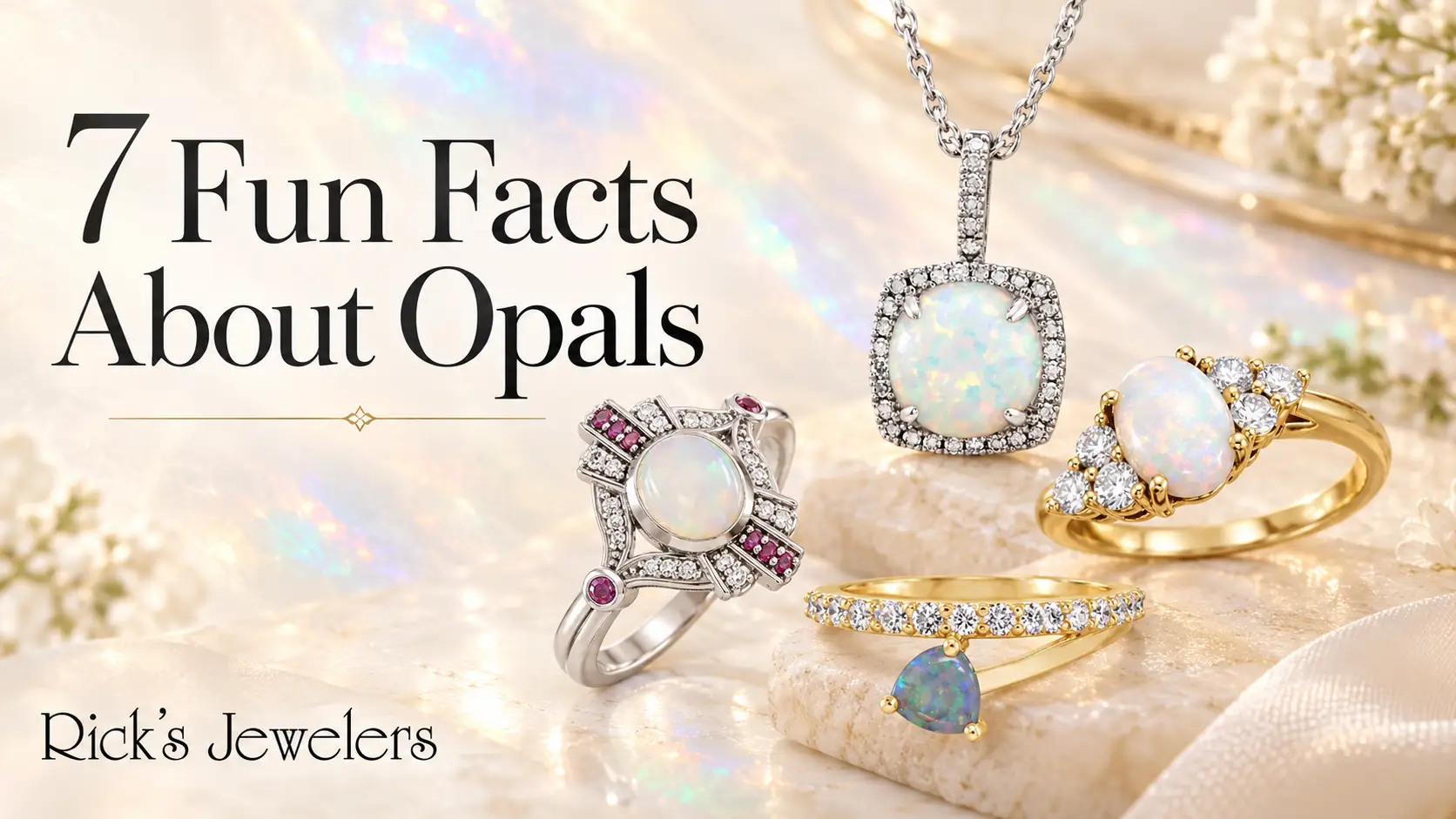
7 Fun Facts About Opals Every Southern Maryland Jewelry Lover Should Know
Few gemstones capture attention quite like the opal. With its shifting rainbow of color locked inside a single stone, it's no wonder opals have fascinated jewelry lovers for thousands of years. Whether you're shopping for a unique engagement ring, a custom-designed pendant, or just love learning about gemstones, here are some fun facts about opals that might surprise you — straight from the team at Rick Jewelers, serving Calvert and St. Mary's County, MD.
1. Opals Are Actually Made of Silica and Water
Unlike most gemstones, which are crystalline minerals, opals are technically a mineraloid. They form when silica-rich water seeps into cracks in rock and slowly hardens over millions of years. Opals can contain anywhere from 3% to 21% water trapped inside their structure — which is part of why they need a little extra care compared to a diamond or sapphire.
2. That Rainbow Effect Has a Name: Play-of-Color
The dazzling flashes of color you see in a quality opal are called "play-of-color." This happens because opals are made of microscopic silica spheres stacked in a grid pattern. As light passes through and bends around these spheres, it splits into the colors of the spectrum — similar to how a prism works. No two opals produce quite the same pattern, which makes every piece genuinely one-of-a-kind.
3. Australia Produces About 95% of the World's Opals
The vast majority of precious opal on the market today comes from the Australian Outback, particularly areas like Coober Pedy and Lightning Ridge. Australia's opal fields have been mined since the 1800s, and the country even named the opal its official national gemstone in 1993.
4. Opals Are October's Official Birthstone
If you're shopping for someone with an October birthday, an opal makes a thoughtful and meaningful gift. Opals share the October birthstone spotlight with tourmaline, but their unmatched color play makes them a standout choice for a custom ring, bracelet, or necklace.
5. There Are Several Types of Opals
Not all opals look alike. Some of the most popular varieties include:
- White opal — light background with softer color flashes
- Black opal — dark background that makes colors pop dramatically, and among the most valuable
- Boulder opal — opal formed within ironstone, often left partially attached to the host rock
- Fire opal — typically orange or red-toned, sometimes without play-of-color at all
6. Ancient Cultures Believed Opals Held Powerful Magic
Ancient Romans considered opals a symbol of hope and purity, while some early European folklore linked opals to good luck and even invisibility. In the 19th century, opals briefly earned an unfair reputation for bad luck — largely thanks to a work of fiction — but that superstition has long since faded, and opals remain one of the most beloved gemstones for custom jewelry today.
7. Opals Need a Little Extra TLC
Because of their water content and relatively softer structure (opals rank about 5.5–6.5 on the Mohs hardness scale, compared to a 10 for diamonds), opals do best in rings, pendants, and earrings that avoid daily wear and tear. Avoid extreme temperature changes and harsh chemicals, and store them away from direct sunlight for long periods. A properly set opal, cared for well, can be enjoyed for generations.
Find Your Perfect Opal Piece in Southern Maryland
Whether you're drawn to the fiery flash of a black opal or the soft glow of a classic white opal, the team at Rick Jewelers can help you find — or custom design — the perfect piece. We're proud to serve jewelry lovers throughout Calvert and St. Mary's County, MD, with expert guidance, quality craftsmanship, and a genuine love for beautiful stones. Stop by or reach out today to explore our opal jewelry and custom design options.
Written by Deborah Naugle